
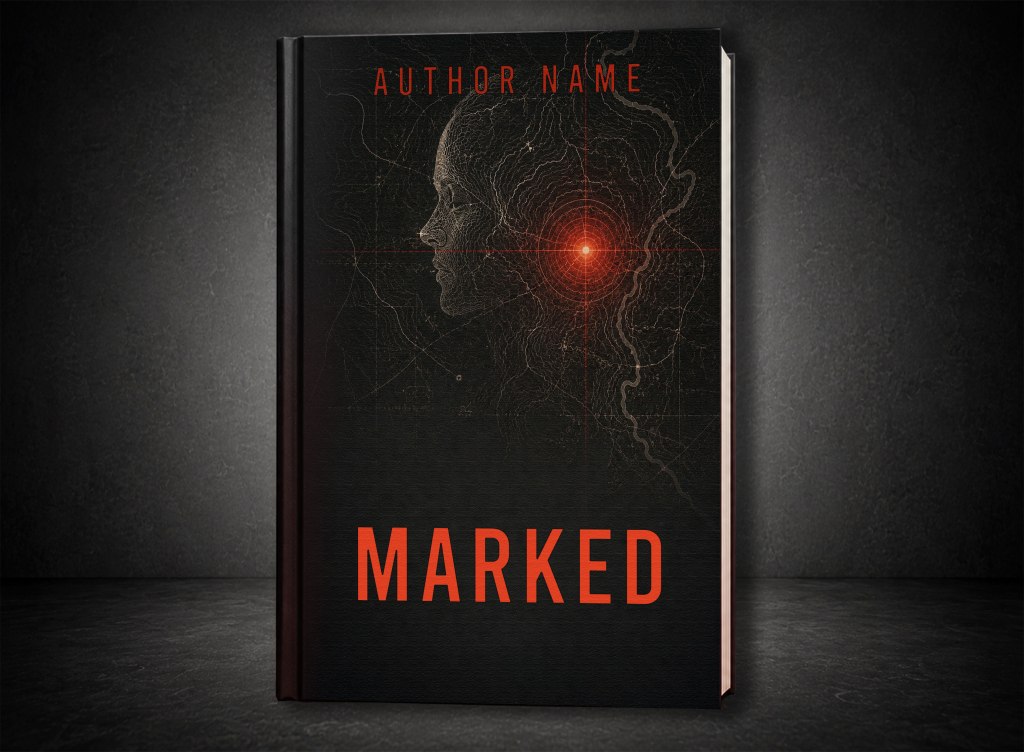
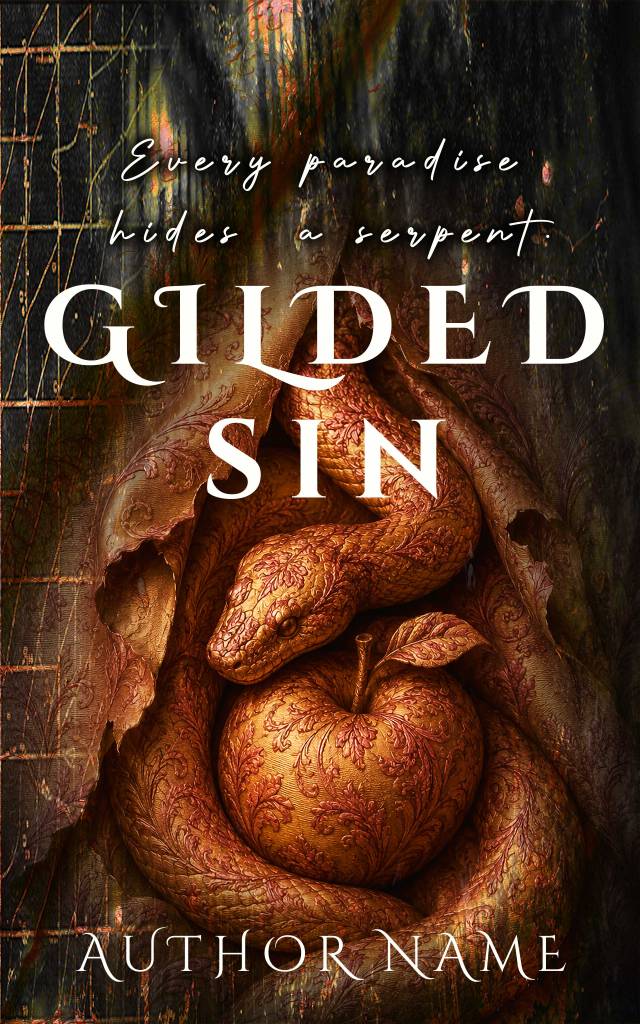
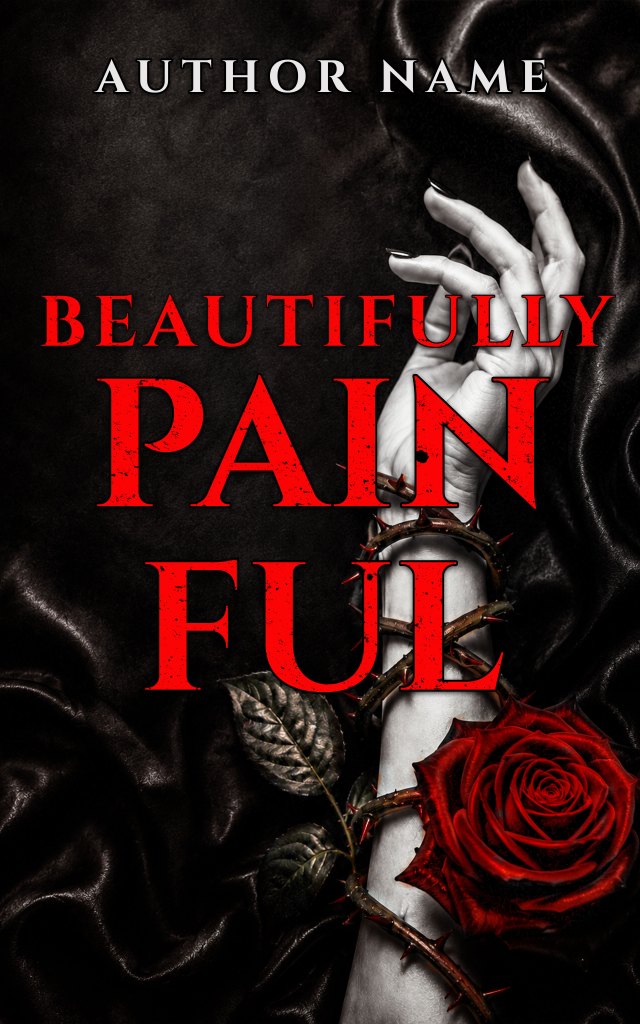
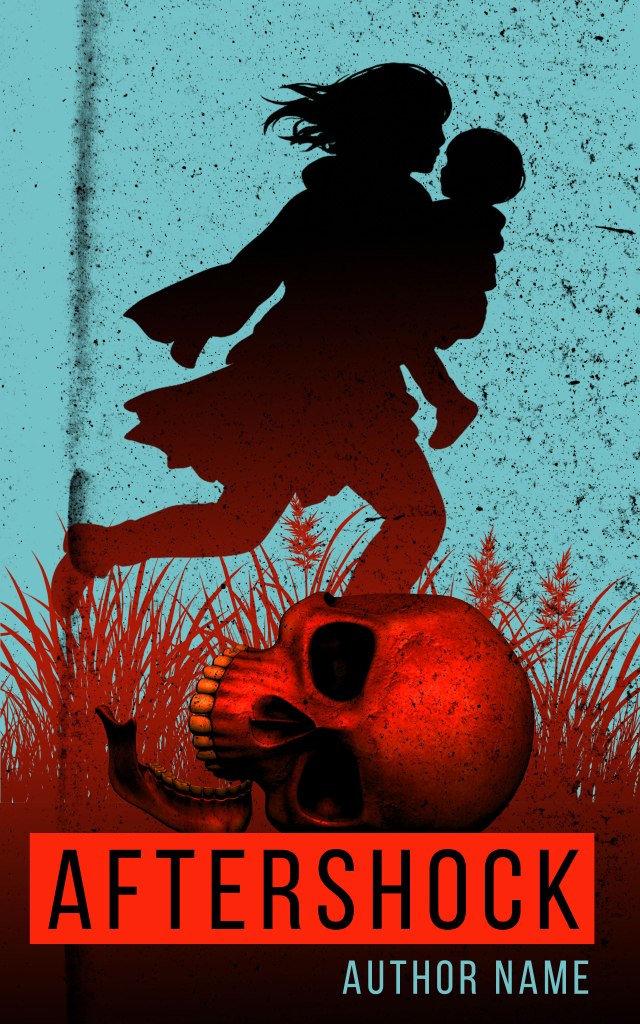
A unique premade cover from my portfolio
🎧 This story has an audio version. Find it on the Coverlog Podcast.
Today I managed to reach a point in digital art that even the writers of Black Mirror probably wouldn’t have imagined could happen without exaggeration.
I was trying to prove to an artificial intelligence that I don’t only work with artificial intelligence.
Yes.
I can see it too.
But let’s start at the beginning.
I create premade book covers. I’m a digital collage artist, I work in Photoshop, and yes, I use AI too.
I recently added this to the About section of my Etsy shop.
Not in tiny print.
Not like this:
“Certain unspecified technological processes may occasionally contribute to the production of visual source material.”
No. Properly.
I explained that some of my covers are created entirely without AI, while for others I use AI to create certain raw visual elements. It might be a flower. A hand. A knife. A person. A background.
Then I cut it out, transform it, retouch it, recolor it, combine it with other elements, and keep working on it in Photoshop until it becomes a book cover.
There is a very simple reason for this.
I am not willing to spend three hours searching stock-photo sites for a knife.
My apologies to art history.
I could do it.
I used to do it.
I can search fourteen stock sites. I can find 87 almost suitable men, one of whom has the right face, another the right coat, and a third the right hand, except unfortunately he is standing on a sunny beach while I need him in a dark forest.
Then I can put all of this together in Photoshop.
There is just one small problem.
I sell the cover for 42 euros.
And only once.
It is a premade cover.
If I spend two days working on it, buy stock photos, search for hours, and then spend several more hours retouching, I am no longer creating an affordable premade cover.
I am providing a custom cover service for a person I have never met, who did not commission it, and who may never even see it.
This is, economically speaking, a somewhat questionable business model.
So I use AI too.
And for a long time, I had no problem with that.
Then somehow the internet managed to give me one.
The Word AI
“AI” has become a strange word.
It no longer means technology.
It means a moral test.
If you say you use Photoshop, nobody asks:
“But you didn’t use Content-Aware Fill, did you?”
If you work with a digital camera, nobody demands proof that you didn’t use automatic white balance.
If a Photoshop filter does in two seconds what would have taken you hours to do manually thirty years ago, nobody stands on a chair and screams:
CHEATING!
But say the word AI, and suddenly you have to explain whether you actually exist as an artist.
And apparently, this got to me too.
Even though I thought it wouldn’t.
And Then It Happened Today
I was talking to ChatGPT about my book covers.
I showed it one.
A thriller cover.
Red car. Black forest. Red sky. Wet blue road. Huge red letters:
DON’T STOP
Then I showed it the original generated image.
The original had a dark forest, a wet road, and two headlights somewhere far in the distance.
That was it.
In the finished cover, the forest had become a red-and-black graphic mass. The road had an entirely different color palette. I created a separate car for it. Integrated it. Changed the lighting. Built the composition. Created the typography.
And I showed it to ChatGPT:
See?
Then I pulled out another one.
A dark romance cover.
I showed it the original image: a hooded man, a few roses, a red ribbon, and a huge empty black area.
Then the finished cover.
Flowers everywhere. New background. New composition. A skull built from flowers. Textures. Lighting. Typography.
And again:
See? Do you see the difference?
And somewhere around here, I stopped.
Because suddenly I could see myself from the outside.
A digital artist sitting at her computer, showing before-and-after images to an artificial intelligence in order to prove to the artificial intelligence that:
she doesn’t only use artificial intelligence.
…
All right.
I think civilization ends here.
But Who Am I Trying to Convince?
That was the truly uncomfortable question.
Because ChatGPT obviously doesn’t care.
It doesn’t have feelings.
It isn’t going to go home in the evening and tell its family:
“You won’t believe the woman I met today. She claimed to be a digital artist, but I think she uses too much AI.”
I was proving it to myself.
And that is slightly less funny.
Somewhere along the way, the idea had crept into my head that maybe I wasn’t working enough.
That if I create a flower in ten minutes instead of spending two hours searching stock sites for it, then somehow it is worth less.
That if I can create an image faster, perhaps I am cheating.
That if I use a new tool, I have to prove that I could do it without that tool too.
And I could.
I just don’t want to.
And perhaps that is the most important sentence in this entire post.
I don’t want to use a worse workflow just to prove that I am capable of using a worse workflow.

Suffering Is Not an Artistic Technique
We have a very strange idea about creative work.
As if value were directly proportional to how much the artist suffered.
If I worked on an image for eight hours, it is more valuable.
If I worked on it for two, suspicious.
If I used thirty layers in Photoshop, art.
If I solved a problem in two minutes with a new tool, cheating.
But my customer isn’t buying eight hours from me.
They are buying a book cover.
I don’t include a suffering report with the final file.
Searching for stock photos: 2 hours 47 minutes.
Masking: 1 hour 13 minutes.
Existential collapse: 38 minutes.
Coffee: 4.
They want to look at the cover and say:
That’s the one I want for my book.
That’s it.
And Yes, I Use AI
I would now like to be able to say this without automatically following it with a twelve-page defense statement.
I use AI.
I use Photoshop.
I use photographs.
I use textures.
I use brushes.
I use my own artwork.
I cut things out.
I repaint things.
I combine things that were never originally in the same image.
That is called digital collage.
AI has entered my toolbox.
It has not become my toolbox.
And I tell my customers that too.
If someone doesn’t want to buy a book cover from me after reading that, that’s fine.
Really.
I am probably not the right designer for them.
If, on the other hand, someone wants a completely traditional workflow, with carefully selected stock photography, many hours of manual manipulation, and an individual custom design process, that exists too.
It just has a different price.
You cannot ask for several hundred euros’ worth of work and pay 42 euros for it at the same time.
Unfortunately, capitalism has not introduced that feature yet.
I’m sure they’re working on it.
So I Learned Something
Not that I should use more AI.
And not that I should use less.
But that I need to stop trying to prove that I have the right to use the tools I work with.
I explain honestly how my work is made.
The customer looks at it.
Looks at the price.
And decides whether they want it.
This was a surprisingly functional system long before artificial intelligence existed.
And if I ever catch myself showing my Photoshop layers to an AI again in order to prove that I am a real artist, I am simply going to turn off the computer.
Because somewhere, surely, there has to be a line.
For God’s sake. I’m an artist.
How did my job go from making pictures to a profession where I apparently have to defend a dissertation on my own existence in front of an algorithm?
And perhaps even more disturbingly:
why was the algorithm the one with enough sense to tell me I didn’t need to?
Continue the Conversation
If this story resonated with you, here are three more you might enjoy.
– Dear Artist, Please Stop Refreshing the Page
When artistic confidence becomes dangerously dependent on what happens after you click “publish.”
– How Am I Supposed to Write a Case Study When I Have No Idea How My Work Was Created?
A completely professional explanation of a creative process I barely understand myself.
– The Biggest Mistake I Made Was Thinking I’d Become an Artist
I wanted to make art. Somehow I became an internet plumber instead.

Every Story Begins with Someone Who Couldn’t Stop Creating
If you’re writing a story that refuses to leave you alone, perhaps it’s already waiting for its cover. Every premade book cover at BoN Editions is created exclusively and sold only once
→ Browse My Shop

Leave a Reply