
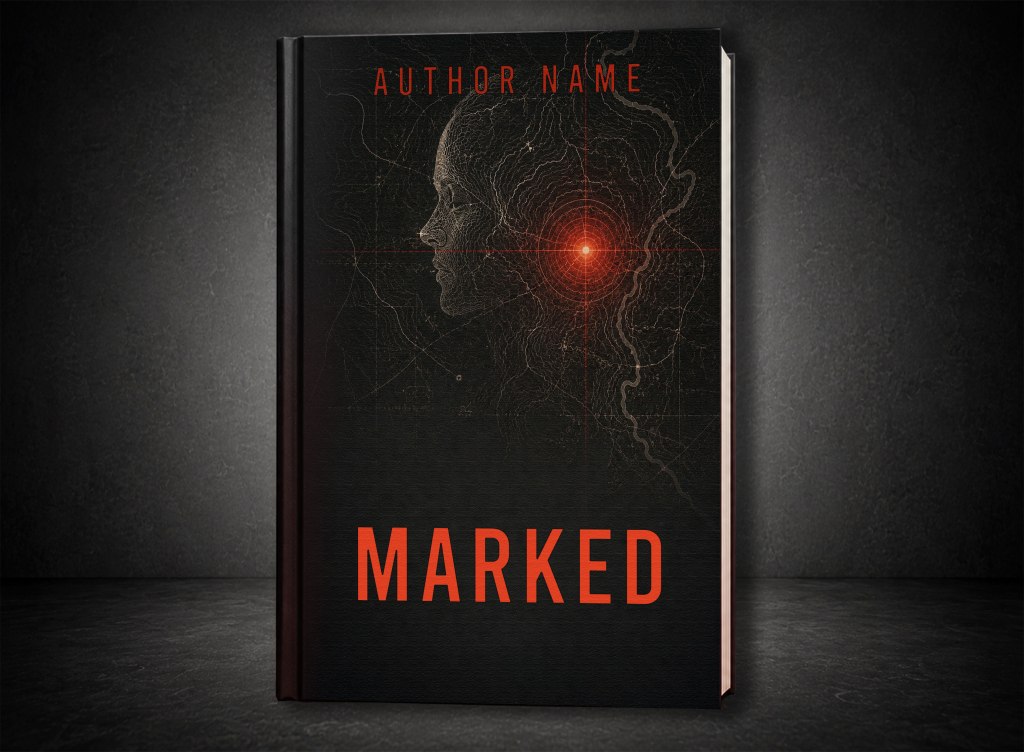
Original premade book cover by BoN Editionshttps://boneditions.etsy.com
🎧 This story has an audio version. Find it on the Coverlog Podcast.
I am not a sociologist.
I feel this is important to establish right at the beginning.
I don’t have a degree in sociology, I don’t have a research team, I don’t have a university behind me, and I’m fairly certain that no ethics committee would have approved the research methodology I have been using over the past few weeks.
In my defense, I wasn’t trying to conduct research.
I was trying to sell book covers.
Somewhere along the way, however, I lost control of the situation, and now I am studying the behavior of authors from several different countries.
I did not ask for this knowledge.
It simply happened to me.
1. Background of the Study
I have a pile of premade book covers.
There are writers.
Writers have email addresses.
In retrospect, this turned out to be a dangerous combination.
Because I committed the socially questionable act of emailing them.
The subject line of my email is roughly:
“I make book covers. Apparently, I’m supposed to tell people.”
Then, in considerable detail, I explain that I create premade book covers for thrillers, dark romance, dark fantasy, and fantasy. I also explain that I sell each cover only once, replace the title and author name after purchase, and never sell the same design again.
So essentially, I am saying:
“Hello. These are finished book covers. Look at them. If you want one, buy it. If you don’t, go back to writing. Everything is fine.”
In fact, I practically say exactly that.
I thought this covered every possible branch of communication.
Oh, how naive I was.
2. Research Question
The original research question was:
“Will anyone buy a book cover?”
However, as the study progressed, several new questions emerged:
Why does someone reply to an email that requires no reply whatsoever?
Why does someone feel the need to formally inform me that they do not wish to purchase a book cover?
What is happening in Canada?
Why do the British click while refusing to speak?
Why do the Germans speak when nobody asked them to?
And when exactly did I become a sociologist instead of an artist?
The last question is particularly concerning.
3. Hypotheses
Before the study began, I had only one hypothesis:
H1:
If I send people my book covers, some of them might buy one.
It was a nice, simple hypothesis.
I liked it.
Unfortunately, several additional hypotheses have since emerged.
H2:
Americans are incapable of simply saying no without complimenting you at least three times first.
H3:
The British are capable of browsing an entire shop while pretending to be communicatively dead.
H4:
Canada may not exist.
H5:
A significant proportion of Germans appear to believe that once an email has been opened, the matter must also be formally concluded through the appropriate administrative procedure.
H6:
If a person tries to sell book covers for long enough, they will eventually begin practicing professions for which they have neither qualifications, authorization, nor emotional preparation.
H6 currently enjoys strong empirical support.
4. Methodology
The methodology of this study is extremely sophisticated.
In academic literature, it would probably be described as:
“Brigitta emailed a bunch of people.”
The research subjects are authors living in different countries.
The researcher — me — contacts them by email and attempts to sell them premade book covers.
Then she observes what happens.
Possible responses include:
A) nothing happens;
B) they open the email;
C) they click;
D) they reply;
E) they explain why they don’t need one;
F) they misunderstand what I am selling;
G) they understand what I am selling but still feel that we need to discuss it;
H) they buy a book cover.
Event H is currently of particular scientific interest.
It is a rare phenomenon.
Observing it in its natural habitat remains a major research objective.
5. Data Collection
Thanks to modern technology, in some cases I can see how many emails were opened and how many people clicked.
This is extremely dangerous knowledge in the hands of someone who originally just wanted to use Photoshop.
In the old days, you sent a letter and had no idea what happened to it.
Those must have been happy times.
Now I send 165 emails and then watch:
Did they open it?
Did they not open it?
Did they click?
What did they click?
Why didn’t they click?
Who is this person?
What do they do?
Why did they reply?
Why didn’t they reply?
Why am I still awake?
At this point, I would like to emphasize that the boundary between research and obsession has not been clearly defined within the methodology.
6. First Finding: People Reply to Emails They Have Absolutely No Need to Reply To
This was the first major surprise.
If I receive an offer for something I’m not interested in, the process goes like this:
- I look at it.
- I don’t need it.
- I delete it.
- I continue with my life.
I thought this was a widely accepted social mechanism.
It is not.
There are people who apparently feel that they absolutely must inform me that they do not require a book cover.
This is roughly equivalent to walking past a bakery, going inside, finding the person behind the counter, and saying:
“Good afternoon. I would like to formally inform you that at this time I do not require a bread roll.”
“I see.”
“I already have a bread roll.”
“All right.”
“From another bakery.”
“Wonderful.”
“I have been working with that bakery for years.”
“Ma’am, please, I beg you, go home.”
I don’t know why anyone would do this.
However, according to my international research, part of the human species considers the formal closure of commercial offers important.
7. American Observation Zone: The Art of the Soft Landing
Several American authors replied.
Usually kindly.
Very kindly.
So kindly that after the first three sentences, you almost start thinking you’ve sold a cover.
“Your work is beautiful.”
Oh.
“It’s really eye-catching.”
Ooh.
“I absolutely love your style.”
OOOOH.
“Unfortunately…”
And that’s where you die.
But politely.
Surrounded by soft pillows.
An American rejection is like someone first tucking you into bed, giving you a cup of hot chocolate, complimenting your hair, telling you that you are a valuable human being, and then informing you that they will never buy anything from you for as long as they live.
By the end, somehow you’re the one thanking them.
8. Canada: The Control Group That May Not Exist
Canada chose a different method.
Canada does not speak.
Canada meditates.
Somewhere thousands of miles away, Canadian authors may have opened my email.
Or perhaps they didn’t.
Maybe they read it.
Maybe they showed it to the dog.
Maybe they are currently looking at one of my covers.
Maybe the entire country collectively decided not to participate in the study.
I don’t know.
Canada tells me nothing.
From a scientific perspective, this is problematic.
Nevertheless, I respect Canada’s decision.
Note for future researchers: Further investigation of Canada is required, provided its communicative presence can first be established.
9. Britain: Schrödinger’s Potential Customer
Britain didn’t say much either.
Britain, however, clicked.
This is an extremely interesting behavioral pattern.
The British author is simultaneously:
not interested, because they don’t reply,
and
interested, because they are currently wandering around my shop.
Until they either buy something or close the page, they are, scientifically speaking, both a potential customer and a completely uninterested stranger.
I shall henceforth refer to this phenomenon as:
Schrödinger’s Customer.
As a marketer — which, unfortunately, I seem to have become somewhere along the way — I greatly appreciate this behavior.
We don’t need to talk.
Really.
I’m not lonely.
I’m not looking for a pen pal.
Go into my shop.
Look at the covers.
Click things.
If possible, click something that says Buy.
That’s it.
Thank you, Britain.
Efficient cooperation.
10. Germany Enters the Experiment
Then the Germans arrived.
And the study suddenly entered its qualitative phase.
One reply essentially said:
“Thank you for your email. I already work with a book cover designer, so I have no need for your services.”
Thank you.
The information has been recorded.
Your file has been updated.
Headquarters has been notified.
The case has been filed in triplicate.
The book-cover emergency has been successfully resolved.
Another author, however, asked me a question:
“Do you even know my books?”
And for a moment, science stopped.
No.
I don’t.
I sell premade book covers.
The covers already exist.
It’s a little like walking into a clothing store and having the salesperson look at you suspiciously and ask:
“But do I know your wardrobe?”
No.
You don’t.
That’s why the clothes are in the shop.
You look at them.
If you like something, you try it on.
If you don’t, you leave.
There is no need to conduct a three-month qualitative study into the history of your closet beforehand.
I explained this — naturally, somewhat more diplomatically.
Only later did I discover that the lady in question was, among other things, a cultural studies scholar, a former state secretary, and a former head of a cultural affairs office.
So somewhere in Germany, there is now probably a former state secretary sitting at home after having the premade book cover business model explained to her through the metaphor of a clothing store by a Hungarian book cover designer.
International relations remain stable.
So far, the Ministry of Foreign Affairs has not contacted me.
11. Then Maren Arrived, and Germany Was Admitted Back Into the Sample
Naturally, you cannot analyze an entire country based on a few emails.
Not even I can do that.
Although by this point I was becoming dangerously confident in my scientific career.
Maren, however, read my email.
Actually read it.
She understood what I do.
She understood which genres I design covers for.
And she told me that if she wrote thrillers, dark romance, or fantasy, she would definitely have found one of my covers that she liked.
But she writes contemporary fiction.
Her new novel takes place in Berlin during the first lockdown in the spring of 2020 and — as she pointed out — as far as she knows, there wasn’t much fantasy involved.
She even added a winking emoji.
At this point, I leaned back in relief.
Germany has humor.
The hypotheses were revised.
The study may continue.
12. Ethical Considerations
Every serious study needs an ethics section.
So does this one.
The research subjects do not know that they are participating in a sociological study.
The main reason for this is that I didn’t know either.
At the beginning of the study, all participants were under the mistaken impression that they had simply received an email from a woman selling book covers.
Technically, this remains true.
No participant was forced to purchase a book cover during the study.
Unfortunately.
Participants are free to withdraw from the study at any time by deleting the email.
Canada has made particularly active use of this option.
During data analysis, the researcher attempts to maintain scientific objectivity.
This is mostly unsuccessful.
13. Limitations of the Study
The study has certain methodological weaknesses.
For example:
The sample is not representative.
The emails were sent at different times.
The authors write in different genres.
Countries are not culturally homogeneous.
Email open data is not perfect.
Clicks do not necessarily indicate purchase intent.
The researcher has a tendency to develop sweeping theories about entire civilizations after every third data point.
The latter is a particularly serious issue.
Furthermore, the researcher has a financial interest in the participants occasionally giving her money.
This may be problematic from the perspective of scientific objectivity.
From the perspective of financial sustainability, however, it would be highly desirable.
14. Confounding Factors
One of the most significant confounding factors in this study is the researcher herself.
Meaning me.
When a recipient doesn’t reply, I think:
“They must not be interested.”
When they do reply, I think:
“Oh God. What happened?”
When they click:
“OH MY GOD, SOMEONE CLICKED.”
When they don’t click:
“Why didn’t they click?”
When they politely reject me:
“Was that genuinely nice or just polite?”
When they reject me briefly:
“What’s their problem?”
The researcher, therefore, cannot be considered a stable measuring instrument.
15. Preliminary Results
Based on observations so far, the following highly scientific model is beginning to emerge:
United States:
“Brigitta, you’re wonderful. Your work is beautiful. The world is a better place because you exist. I don’t want anything.”
Canada:
[snow falls quietly in the distance]
United Kingdom:
[click]
Germany:
“Dear Madam, I hereby inform you that I do not require a book cover. The reasons are set out below.”
Hungarian Researcher:
“Please. I just wanted to use Photoshop.”
16. Directions for Future Research
The next phase of the project must investigate several important questions.
- How many clicks are required before the researcher stops checking the statistics every five minutes?
Preliminary result:
No such number exists.
- Is there a country where people simply buy the cover without first providing material for a cultural anthropology study?
Research ongoing.
- Will Canada ever respond?
A long-term longitudinal study is required.
- Can a British click be converted into money?
This is currently one of the most important research questions and, entirely coincidentally, also one of considerable personal interest.
- How many professions must an artist learn before she is finally allowed to be an artist?
Fields currently identified include:
graphic design,
marketing,
SEO,
copywriting,
database management,
email marketing,
website building,
social media,
statistics,
market research,
and now:
international comparative sociology.
The list is expected to expand.
I am afraid of next month.
17. Funding Statement
This research received no external funding.
This is unfortunate.
The researcher is funding the study herself while actively attempting to persuade research participants to contribute to the sustainability of the project by purchasing book covers.
Financial support may be provided voluntarily through the Etsy shop.
Supporters receive a book cover in return.
According to the current state of scientific knowledge, this is known as a purchase.
18. Conflict of Interest Statement
The author reports a severe conflict of interest.
She very much wants the participants in the study to buy things from her.
Furthermore, she has positive feelings toward her own book covers.
Impartiality therefore cannot be guaranteed.
19. Acknowledgments
I would like to thank:
the American authors who compliment me before rejecting me;
the British authors who quietly click around;
Canada, although it remains unclear exactly what I am thanking it for;
the German authors, who ensure that an adequate amount of qualitative data remains available;
and especially the lady to whom I explained how premade book covers work using a clothing store as an example.
Without you, this research would not have been possible.
Admittedly, I would still like to sell a book cover.
But you can’t have everything.
20. Conclusion
I am an artist.
At least, that was the original plan.
I was supposed to make pictures.
Work with colors.
Argue with myself about fonts.
At two in the morning, I was supposed to wonder whether this particular shade of red says “bloody thriller” or “cheap ketchup.”
Instead, I am currently building databases, sending emails, monitoring open rates, comparing click-through rates by country, analyzing qualitative responses, observing cultural communication patterns, and slowly becoming qualified to give a conference presentation titled:
“Transnational Characteristics of Responses to Unsolicited Book Cover Offers in Digital Post-Capitalism.”
I have no idea what that means.
But it sounds excellent as a conference title.
My original question was simply:
“How do I sell my book covers?”
The answer, so far, appears to be:
“Build an international author database, learn marketing, write a blog, do SEO, send hundreds of emails, analyze cultural behavior patterns, and try to remember that once upon a time you were an artist.”
Please.
I am an artist.
How the hell did I become an international marketing sociologist, and when do I get my Photoshop back?
Appendix A — Quick Field Identification Guide
If the reply contains three compliments followed by the word “but”:
probably American.
If there is no reply, but someone is wandering around your online shop:
possibly British.
If there is no reply and nothing else happens:
Canada, or simply the internet.
If you receive detailed information explaining why someone does not require what you’re selling:
the German hypothesis has received further support.
If someone finally buys something:
DO NOT ANALYZE IT.
DO NOT ASK WHY.
DO NOT MAKE A CHART ABOUT IT.
Change the title and author name on the cover.
Send it.
Shut up.
That was the business model in the first place.
Continue the Conversation
If this story resonated with you, here are three more you might enjoy.
– The Biggest Mistake I Made Was Thinking I’d Become an Artist
I thought I’d be making art. Instead, I became an internet plumber trying to keep websites, algorithms, SEO, and sales platforms from exploding.
– How to Get Noticed on the Internet? Build a System. Then Wait.
Apparently, making good work isn’t enough. First you have to build an enormous digital machine so the internet can eventually discover that you exist.
– The Mentor User Manual (That Somehow Never Comes in the Box)
What happens after you finally share your work with the world? More emotions than most people expect.
If, after all this international research, you’d like to see what caused the whole mess in the first place, take a look around my shop.
Every premade book cover is unique and sold only once.






Leave a Reply